|
Conservation Report - Treatment -
Paint Relaying and Fixing
© Stephen Rickerby |
| Relaying
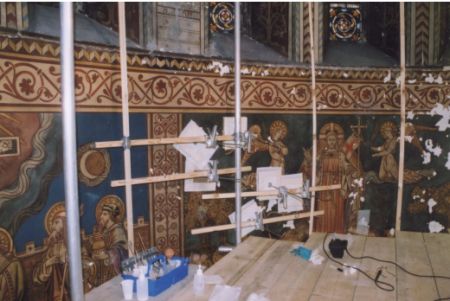
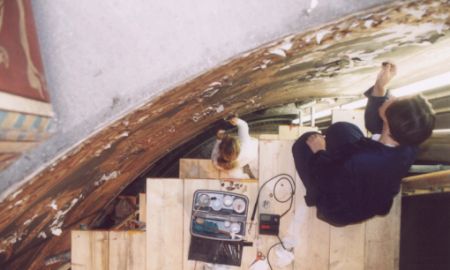
and fixing the flaking paint were the main objectives of
the treatment programme. These views of the painting
scheme from above illustrate how severe and extensive the
problem was before treatment. |
© Stephen Rickerby
|
© Stephen Rickerby |
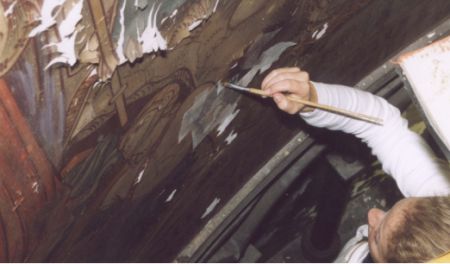
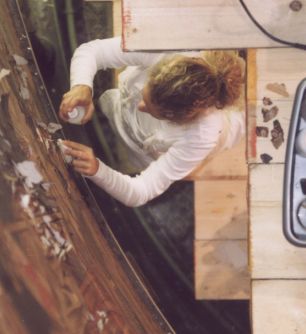
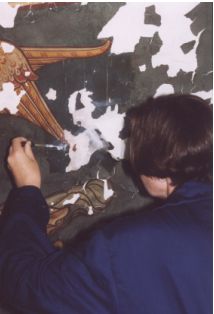
Stage 1 (left):
lens
tissue was applied over the lifted paint flakes with
misted water, in order to secure and relax them
before fixing. IMS was then injected as a
pre-wetting agent before applying the adhesive
|
© Stephen Rickerby |
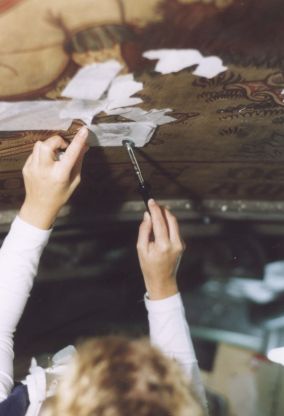
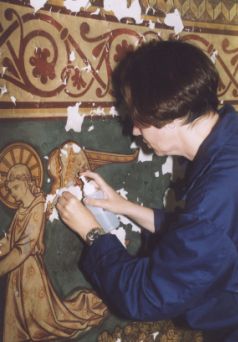
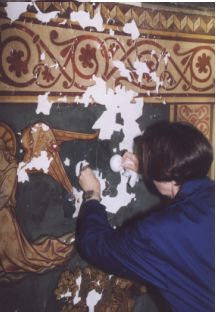
Stage 2 (left):
an
acrylic dispersion (Primal AC33™) was applied
under the paint flakes and/or through the lens
tissue by pipette or syringe. Varying concentrations
were employed, depending on the severity of flaking
|
© Stephen Rickerby |
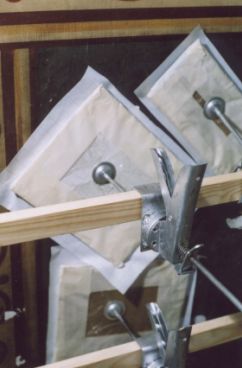
Stage 3 (left):
The
deformed flakes were gently rolled and pressed back
in place with a cotton pad wrapped in silk. Excess
adhesive on the surface was removed with dampened
swabs Afterward, the lens tissue was peeled back and
removed. Typically, the whole relaying and fixing
process needed to be repeated a number of times,
particularly for severely deformed areas of flaking
|
© Stephen Rickerby |
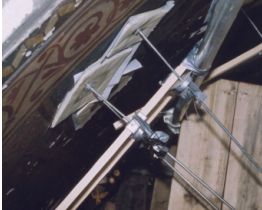
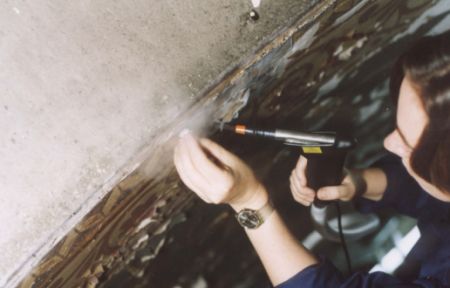
| An
ultrasonic humidifier was also employed as an
additional means of relaxing the severely deformed
and lifted paint flakes. An extremely fine, cold
mist produced by the humidifier is heated by the
held-held pencil (above)
to a desired predetermined temperature, which
remains at a constant level. |
Treatment
materials and procedures
|
|
material
procedure/purpose
|
|
|
|
|
industrial
methylated spirit (IMS)
|
|
|
|
|
|
Primal
AC33™ (10% in water
|
initial
adhesive injection (to enable maximum
application and flow behind flakes)
|
|
|
|
|
Primal
AC33™ (25% in water
|
second
adhesive injection, if necessary
|
|
|
|
|
Primal
AC33™ (50% in water
|
third
application, if necessary (behind flakes only)
|
|
|
|
|
Scotchlite™
glass microspheres
|
added
to Primal AC33™ solutions as a bulking
agent, in order to bridge gaps between
permanently deformed flakes and the plaster
ground
|
|
The
materials and procedures shown in the table (left) formed the basis of the conservation treatment. Primal AC33™
is an acrylic dispersion with the following chemical
composition: ethyl acrylate 60%; methyl methacrylate
40%; and ethyl methacrylate (unknown). Its
non-volatile concentration is about 46-47%.
Scotchlite™ glass microspheres are synthetic
spheres resembling borosilicate glass, with a
particle size averaging 5 –100µm. Being
chemically inert, they make ideal fillers to add to
adhesive mixtures. |
|
|